Fire
and Forest -- Norm
Walker on Land and Fire Management (Part 1)
From the Idyllwild Town Crier -- October 2008
From the Idyllwild Town Crier -- October 2008
|
|
|
|||
|
|
Fire
and Forest -- Norm
Walker on Land and Fire Management (Part 1)
From the Idyllwild Town Crier -- October 2008 |
|
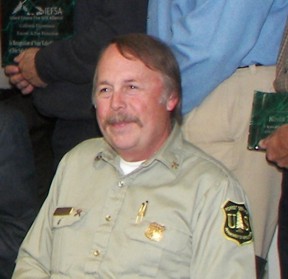
Norm Walker is someone you really want to listen to about fire. He recently retired from the forest service after 36 years of fighting fires, with his last job as our USFS district's fire chief. He still fights fires when called, and we at the Fire Safe Council are lucky to have him on our board. He has fought fires all over the west, knows about every inch of our mountain, and is thoughtful and articulate about his vast experience. Over coffee recently, I began by asking his thoughts about fall fires. "In Southern California, any fire can blow up with wind," he said. "The uniqueness of fall is how dry everything gets. Fuel moisture in the chaparral is at its lowest point, along with the dry air. All the planets line up against fire fighters." Dry conditions, low humidity, blowing wind-all bad-but that's not all. "It's the wind changes that are really dangerous," he went on. "The Esperanza started out dominated by the topography, going south up the mountain. When the Santa Anas strengthened, the winds shifted west." [The Esperanza was the October 26, 2006 fire in which 5 forest service fire fighters were killed near Twin Pines in extraordinary wind dynamics.] Since I am a bit obsessed about reducing fuel loads on the mountain, I asked Norm if he really thought lightening the fuel load made a difference to fire fighters. He said it did. "There are huge differences in treated and untreated land. It's true that treated chaparral won't stop Santa Ana driven fires, but they represent only 2% of fires. All the others are hot summer day fires, and the treated areas will either stop or slow those fires." He went on to talk about the ecological impact. "Light fuel loads still burn but with less intensity. They gobble up acres but do less damage to the soil. Downed logs will burn so hot the fire will sterilize the soil and turn it to sand." He pointed out that the Esperanza fire did not burn hot enough to damage the soil. People driving north to Banning can see both weeds and chaparral growing back, though he said that in a year or two the growing chaparral plants will shade out the weeds and eliminate them. I asked what he thought of the conditions around our communities. "Its as good as its ever been," he said. "There are still some problem areas. Trees are still too thick in areas, but I understand why people don't want to take them down. The Wilderness needs work. There are still too many snags [standing dead trees]." So what can residents do? "Limbing is really helpful. [Pruning branches off the lower portion of the tree.] If fire stays on the ground, fire fighters have a chance." Norm also pointed to research after recent fires that showed that ground fuel (needles and leaves) led fire to many a house that burned. Houses need a protective barrier with this fuel raked. Norm's views of fire fighting are interwoven with issues of land management. He sees the mountain's forest and chaparral as a dynamic biosystem, with fire as a natural and necessary component of health. I will address this more in a following column on public land management issues. |